Client Retention vs Acquisition: What Agency Owners Should Prioritize
Client retention vs acquisition is the real growth call for agencies, with agency client churn, renewal tracking, and reminders protecting revenue.
Winning a new client feels good, but losing one hurts twice. You lose the monthly fee, then you spend time replacing it. That is why client retention vs acquisition is one of the hardest calls in agency ownership.
Recent 2026 benchmarks put annual churn for marketing agencies in a wide range, and retainer-heavy shops start to feel pressure when churn passes 20%. At the same time, acquiring a new client often costs far more than keeping one already on board.
That gap changes the math on growth. Before you chase more leads, it helps to see where renewal risk is hiding.
Why agency client churn cuts deeper than it looks
Agency client churn usually starts with small signals. A client stops replying fast. A report arrives late. A new decision-maker asks what the agency is really doing. None of those moments feels fatal on its own. Put together, they point to a renewal problem.

Recent 2026 data puts annual churn for marketing agencies between 20% and 50%. Retainer-based firms start to feel pressure when churn rises above 20%, because each loss removes recurring revenue that has to be replaced.
For a recent benchmark on agency retention, see client retention statistics for agencies.
Churn rarely feels sudden inside the account. It usually feels sudden only after the warning signs were missed.
If you want better churn for marketing agencies, watch the handoff between delivery, reporting, and renewal. That is where clients decide whether the work still feels worth the fee. Without clear contract renewal tracking, the next expiry can slip by while everyone stays focused on delivery.
Retention vs acquisition is a margin question
Retention vs acquisition is mostly a cash-flow problem. New business helps you grow, but it comes with proposals, discovery calls, sales follow-up, and unpaid time before the first invoice lands. One 2026 benchmark says acquiring a new client can cost 5 to 25 times more than retaining an existing one. For a deeper look at agency churn KPIs, see client churn KPIs.
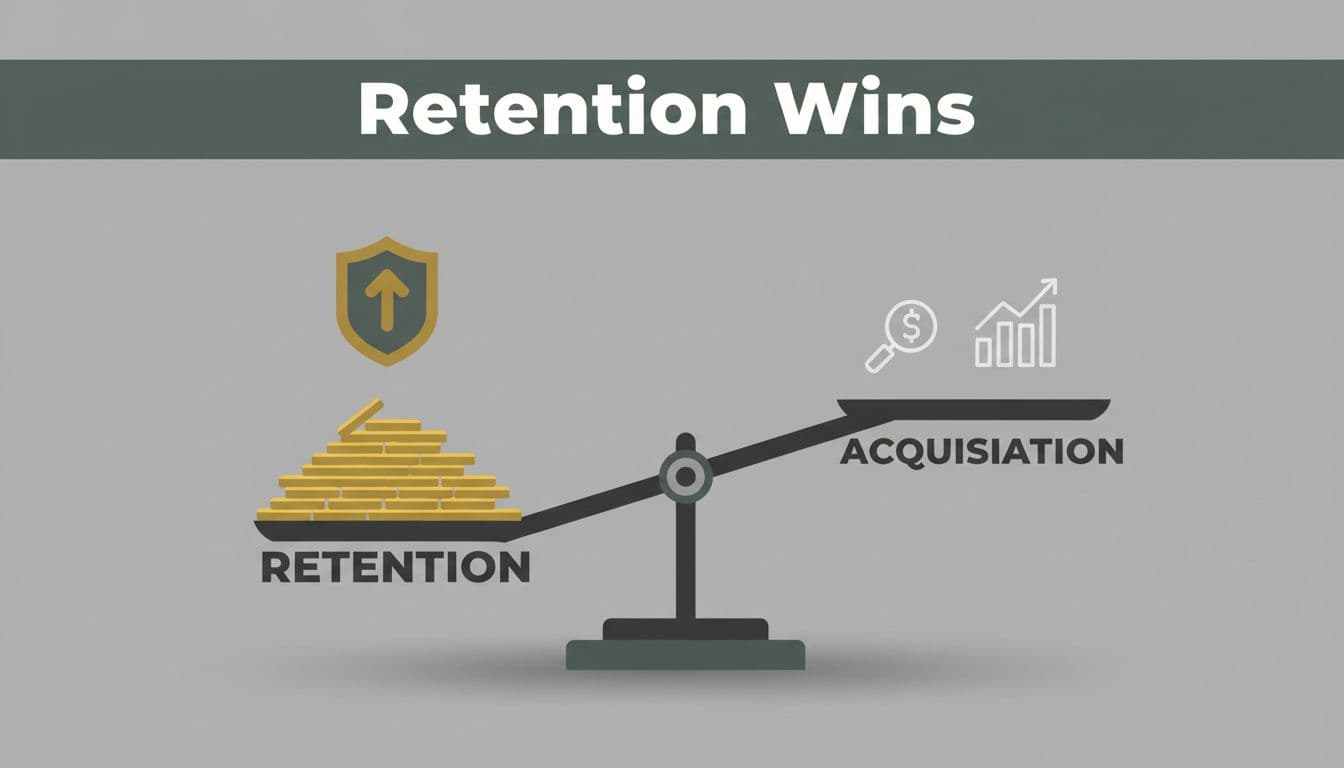
A quick side-by-side view makes the tradeoff easier to see.
| Area | Acquisition | Retention |
|---|---|---|
| Time | Sales cycles take weeks or months | Renewals happen inside existing accounts |
| Cost | Paid media, proposals, and sales time add up | Account reviews and reminders cost less |
| Risk | The deal may never close | The client already knows your work |
| Payoff | Adds new revenue | Protects recurring revenue |
The table makes the point plain. Acquisition can grow the top line, but retention protects the margin you already earned. For client retention for marketing agencies, the smarter question is not whether to sell more. It is how to keep the revenue you already have.
How agency teams can reduce client churn
If you're asking how to reduce client churn agency teams can actually control, start with the moments where clients drift away. The answer to how to help churn move down is to make renewals visible before the client starts thinking about alternatives.
Good retainer management software helps because it turns hidden dates into a daily process. It shows what expires next, flags the urgent accounts, and gives the team a clear place to act.

A few habits make a big difference:
- Assign one owner to every renewal. If nobody owns the date, everyone assumes someone else does.
- Review value before the final month. Clients should hear the case for renewal while there is still time to fix problems.
- Send contract expiry reminders at 30, 14, and 7 days. That spacing gives clients time to respond without feeling rushed.
- Record the outcome of every renewal. The next cycle gets easier when the team knows what happened last time.
That is where the right tools help. The contract renewal tracking tools page shows how a dashboard can keep all of this in one place.
If you want a simple way to test the process, you can Start Free and build your renewal list before the next expiry slips by.
How to keep retainer clients without adding chaos
Knowing how to keep retainer clients is easier when the team is not relying on memory. A short weekly renewal review works well if the dates are accurate and the owner is clear.
The KeepClient FAQ covers common questions about reminders, imports, and team access, while the pricing plans help smaller agencies start without overbuying software.
That matters because renewal work should feel routine, not heavy. When the team can see contract history, next steps, and revenue at risk in one place, renewal conversations get sharper. They also get shorter, because nobody has to dig through spreadsheets or old threads to find the facts.
For agencies dealing with agency client churn, that clarity is worth more than another round of prospecting. The less time your team spends hunting for dates, the more time it has to show value where it counts.
The growth choice that pays twice
The agencies that grow cleanly do one thing well. They treat renewals as part of delivery, not an afterthought. Once you can see which accounts are drifting, client retention vs acquisition stops being a vague debate and becomes a daily habit.
Track the dates. Send the reminders. Give every client a clear reason to stay before they have to ask. That is how strong revenue stops leaking out the back door.